Getting Started
If you have not already registered, Finish-Time prompts for your Club Name and License Key each time it starts. If you are evaluating the software, click Demo. Otherwise enter your club’s name and license key, then click Register. You can copy the license key from the account used to purchase it at finish-time.com.
Getting to Know Finish-Time
Finish-Time uses a tabbed document interface (TDI). Staging, registration, editing, and publishing live in dismissible tabs, similar to a modern web browser. This design reduces the number of extra windows and dialogs while keeping every function within easy reach.
You can also resize the user-interface components. The benefit becomes clear when you run Finish-Time on a laptop in the back of a timing vehicle with sun in your eyes and only a trackpad to work with—larger controls make the job easier.
Behind the scenes, Finish-Time handles data acquisition, sorting, and penalty calculations automatically as drivers finish. During a timed event the operator’s main tasks are staging drivers and assessing penalties during or after each run.
In this article
The User Interface
The main window contains a Toolbar at the top and the Drivers List on the left. Below the toolbar are the Function Tabs, which behave like browser tabs. The Timing tab cannot be closed; the others can be dismissed as needed.
- Timing
- Finish-Time’s Timing and Scoring interface. Stage drivers, apply penalties, and manage all timing aspects of the event. This tab cannot be dismissed.
- Registration
- Database management. Register, re-class, or delete drivers from the database.
- Results
- View or edit run times and penalties at the end of the event and before publishing results.
- Bumping
- Move drivers to another class when required. Clubs that do not bump drivers can ignore this tab. See Auto-Bump configuration for one-click bumping.
- Event Properties
- All settings for the current event, including date, chair, location, and car classes.
- Report Setup
- Customize printed reports (Results, Drivers List, Log Sheets, Worker Assignments, Event Stats, and Income Report). Change printer settings, choose landscape or portrait, and adjust margins.
- Web App Layout
- Choose a style sheet that matches your club’s website and optionally add a hyperlink to the web page menu (for example, a link back to the current year’s results list).
- Assignments
- Group drivers and assign event worker positions.
- Reconcile
- Event income reconciliation and reporting.
- Season Points
- Shows all competition event points and lets you manage club points such as monthly meetings and other activities your club tracks through the year.
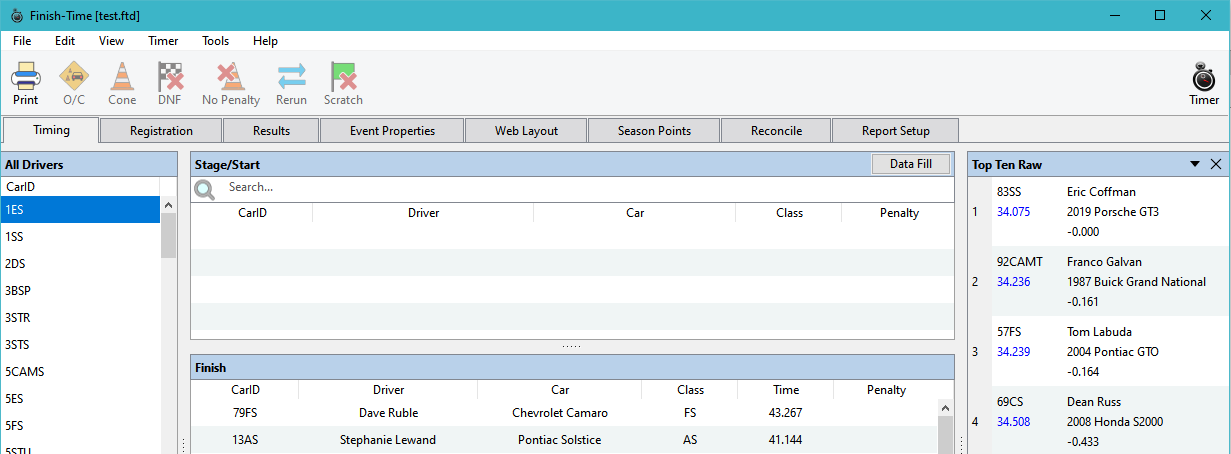
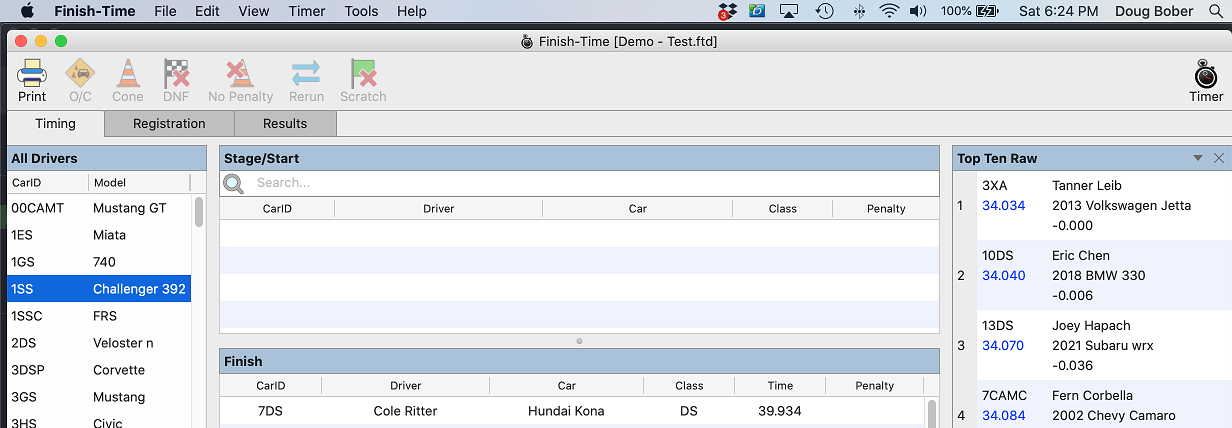
To open any Function Panel, choose it from the View menu.
Drivers List
The Drivers List sits on the left side of the main window and shows every driver in the database. You can limit it to registered drivers only. The list remains visible no matter which Function Panel is active.
Select View > Drivers List, or right-click anywhere in the Drivers List.
- Table View Options
- Default view. Drivers appear in a table sorted by CarID.
- Group by Class
- Hierarchical list grouped by class and sorted by CarID.
- Group by Run Heat
- Hierarchical list grouped by assigned Run Heat and sorted by Grid Position.
- Group by Work Heat
- Hierarchical list grouped by assigned Work Heat and sorted by Grid Position.
- Show CarID's Only
- Shows only CarIDs, sorted by CarID.
- Sort Descending
- Reverses the sort order. Groups follow the selected grouping; Table View sorts by CarID.
- Show CarID's and Last Name
- Shows CarID and last name in table or hierarchical view.
- Show CarID's and Car Model
- Shows CarID and car model in table or hierarchical view.
- Show Registered Drivers
- Regardless of other view settings, displays only registered drivers.
The Drivers List is the quickest way to reach any driver. Right-click a driver to open a context menu with the view options above plus additional actions such as editing results, changing registration status, or staging the driver. The menu is available no matter which Function Panel is active.
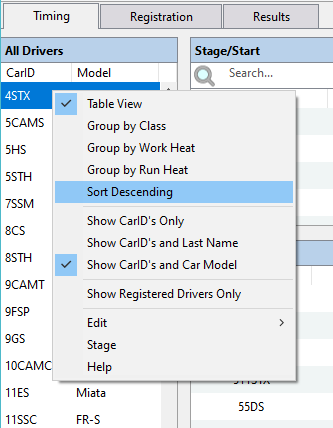
 .
.
Resize the Drivers List by dragging the vertical separator left or right to suit your screen.
Accessory Panel
The Accessory Panel sits on the right side of the window. By default it shows the Top Ten Raw times. Click the menu widget (left of the close widget) to switch to Top 10 Indexed Drivers or, when using a RaceAmerica T-Link timer, the T-Link Battery and Radio Integrity panel. Click the close widget to dismiss the panel. To reopen it, choose View > Accessory Panel and select the panel you want.
Resize the Accessory Panel by dragging its vertical separator. Like the Drivers List, it stays visible regardless of the active Function Panel.
Notifications
Finish-Time displays a notification icon at the bottom of the window when minor events occur. Click the icon to open the Notifications panel, or choose View > Notifications.
Program Concept
Finish-Time follows the classic autocross “first out, first in” model. When car #1 leaves the start, followed by car #2, car #1 is expected to finish first, then car #2. You can still run more than one car on course at a time; the only practical limit is the capability of your timer.
Workflow can be divided into five simple steps:
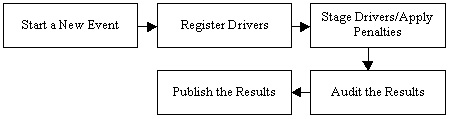
Because Finish-Time is cross-platform, an event database (.ftd file) created on one platform works on the other. The same license key works on both. You can therefore run the Windows version at the event and later edit and post results on a Macintosh at home.
Moving between platforms is straightforward—both versions behave the same way and follow their operating system’s human-interface guidelines. Message dialogs that ask for a Yes/No or OK/Cancel response may use slightly different wording on each platform so the experience feels natural to Windows and Macintosh users alike.
PAX Indexes
PAX Indexes are derived from the Chicago Region SCCA. When you create a new season database, the standard classes and indexes are stored in the .ftd file and shared by every competition event added during the season. You manage this list in the Event Manager.
Use the Event Manager to check for and download the latest PAX Indexes from the Finish-Time website. Updated indexes are posted as soon as they become available, including any mid-season changes.

The PAX Index date appears in the status bar at the bottom of the application window.
Timer Control
When Finish-Time opens the serial port, the timer is placed online and finish signals are processed. To ignore finish signals—during a worker change-over or while training a new operator—you can take the timer offline without turning it off. While offline, the Timer button on the right side of the toolbar displays a red caution animation.
Take the Timer Offline
Choose Timer > Online, or click the Timer toolbar button and select On-Line. The timer goes offline and finish signals are ignored—ideal during course-worker change-overs.
Put the Timer Online
Choose Timer > Online, or click the Timer toolbar button and select On-Line. The timer returns online and finish signals are processed again.
Reset Cars on Course
If your timer posts a Start signal (some models do not), the corresponding driver is highlighted green in the Stage/Start list. If the highlighting falls out of sync, choose Timer > Reset Cars on Course (also available from the Timer toolbar button).
Create a Season Event Database
All competition events and points for a season live in a single database. This lets Finish-Time calculate both competition points and any optional club points (for example, points for chairing an event) even while a timed run is in progress. If your club schedules 12 autocross events, all 12 are stored in the database you create next.
Click File > New Database.
The New Season Database wizard appears. You have two choices: Import Properties from a Previous Event (for example, last year’s Finish-Time database) or Use Default Properties.
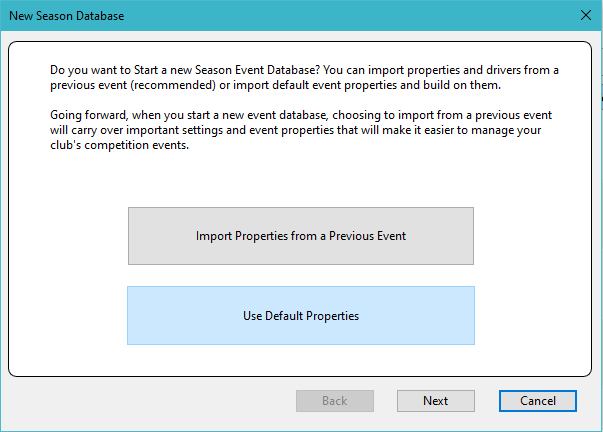
If you choose Import Properties from a Previous Event, a file-selection dialog appears so you can locate that database.
Whichever option you select, you can still update classes and PAX indexes. Click Next.
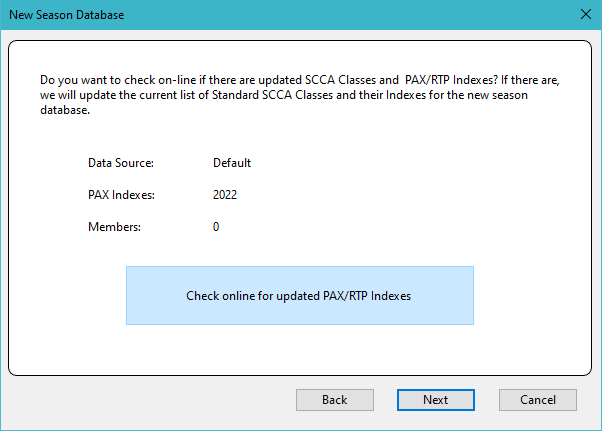
Select Check on-line for updated PAX/RTP Indexes if you want Finish-Time to retrieve the latest indexes from our website. Click Next.
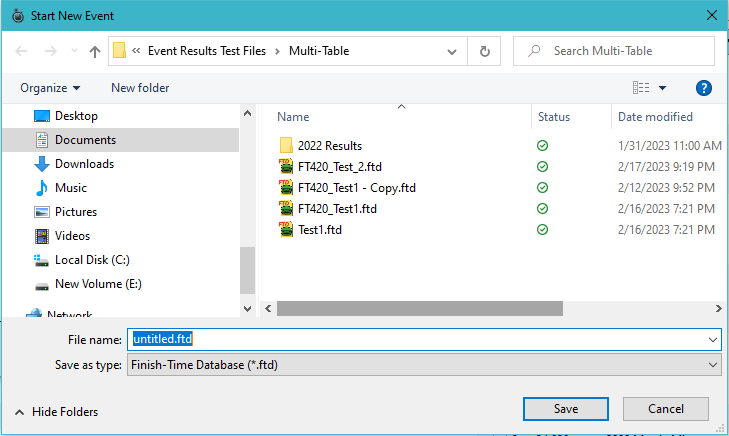
Choose a location to save the database.
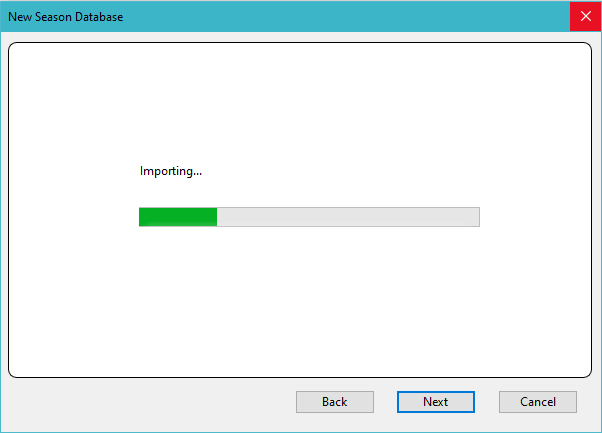
The import process runs and updates the PAX indexes as needed.
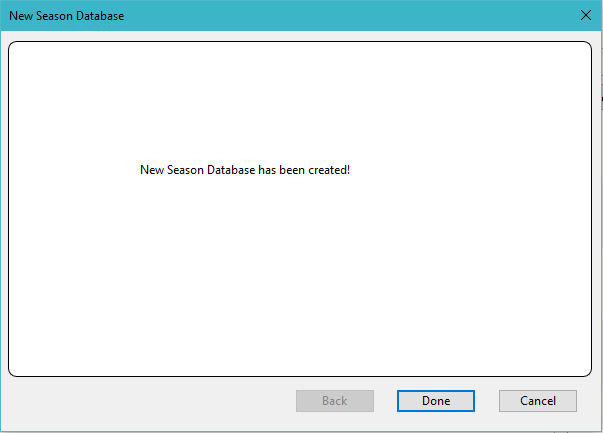
You now have your first season database. Next: create your first competition event.