Starting a New Event
All competition events for a season live in a single Finish-Time database. They share attributes such as the Standard Classes and Indexed Classes. Moving the database file from one computer to another preserves every season attribute.
- Select Tools > Event Manager.
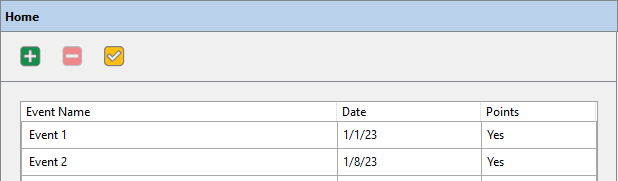
- Make sure the Home panel is selected on the left side of the Event Manager window, then click the
 toolbar button.
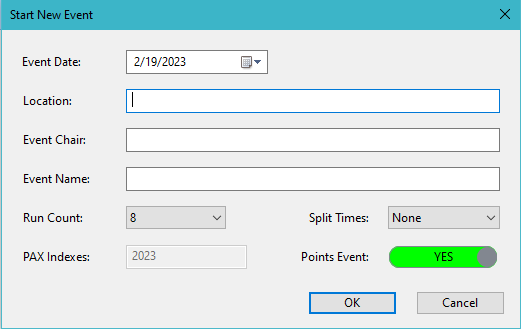
 - Enter the event Location, Chair, and Name. Run Count is the number of timed runs each driver is expected to take. Split Times defaults to none; with additional timing units you can capture up to two split times between Start and Finish. Points Event defaults to Yes. Choosing No excludes the event from the final points tally. These attributes can be changed at any time.
- Click OK to create the event, then close the Event Manager window.
In this article
- Importing Drivers
- Driver Registration
- Bumping Drivers to a different class
- Deleting Drivers
- Assignments
- Event Properties
Importing Drivers
Importing drivers from MotorsportsReg.com eliminates re-entering the same data for every event. You can also Finish-Time first verifies each driver’s CarID and Barcode. Drivers that fail to import are cached so that you can take corrective action before the event.
Motorsports.reg Importing Options
- Downloading a custom data report.
- Direct access by using the Motorsports.reg REST API. This requires a Premium Organizer accout.
Custom Data Report
For quick, automated importing and registration based on online payment status, create a custom data report in your MotorsportsReg admin account.
- Select File > Import Motorsports.Reg > Text File .
- In the Files of Type drop-down choose *.csv (comma-separated) or *.txt (tab-delimited).
- Browse to the file and click Open.

Motorsports.reg REST API
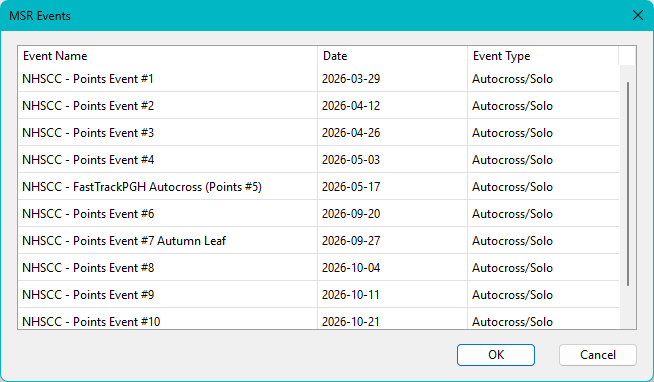
- Select File > Import Motorsports.Reg > API.
- Select the required Event.
- Click OK.
Custom MSR Report for Finish-Time
MotorsportsReg already holds the data Finish-Time needs. Create a custom report that includes the required fields for the best experience.
- Log into your MotorsportsReg admin account and open the event.
- Choose Reports > Custom Reports.
- Click Create New Report.
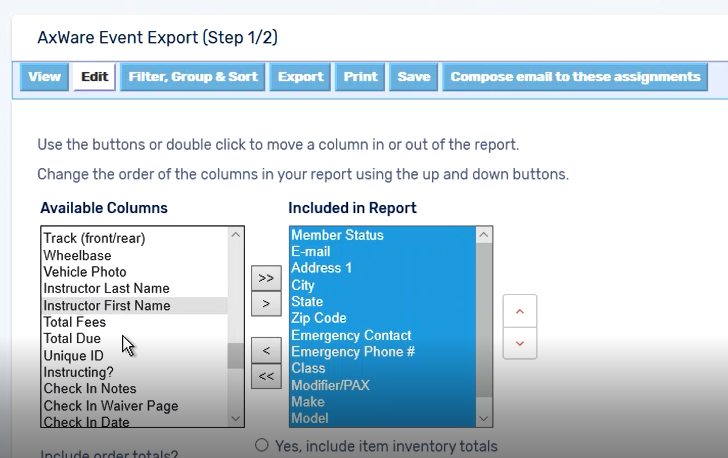
- From Available Columns, move the following items into Included in Report (order does not matter):
- Member Status
- Address 1
- City
- State
- Zip Code
- Emergency Contact
- Emergency Phone #
- Class
- Modifier/PAX
- Make
- Model
- Year
- No.
- First Name
- Last Name
- Paid in full?
- Member Types
- Mem. Expires
- Member #
- Unique ID
- Click Save.
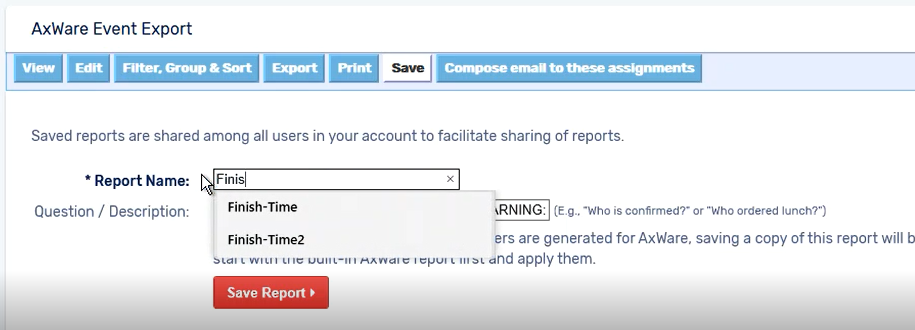
- Give the report a unique name, update the description if desired, and click the red Save Report button.
- Click Back to Report List.
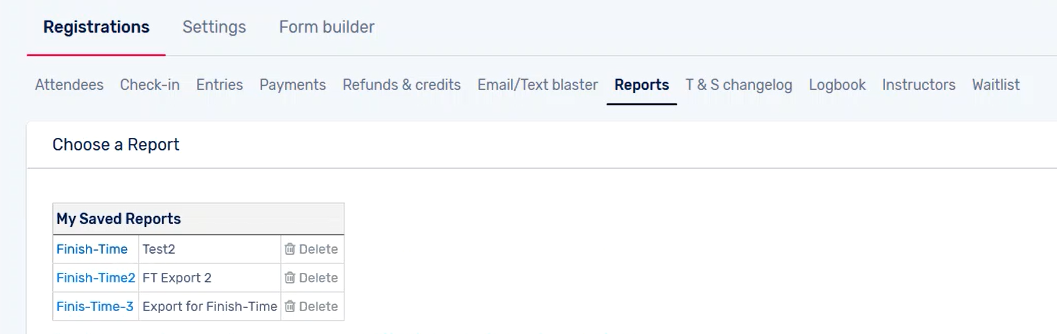
- Your custom Finish-Time report now appears near the top under My Saved Reports and can be used for any future event.
Finish-Time’s Importing Model
While importing MotorsportsReg data, Finish-Time checks for duplicate CarID and Barcode values. As you add events, the driver/member data grows, but the rule remains: no two drivers may share the same CarID (number/class) or Barcode. An algorithm compares incoming records with existing ones. Any duplicates are sent to the Import Fault table for you to resolve.
Import Faults
To view faulted import data, select Tools > Resolve Import Faults. Change the CarID or Barcode as needed to correct the issue listed for each driver. Use the + and - buttons to Register or delete the Driver.
Driver Registration
Each driver is identified by a CarID—a unique key used for staging during run heats. The CarID is formed from the car number and class with no spaces. To keep entries consistent, Finish-Time removes any spaces and converts lowercase letters to uppercase.
Using a unique key for each driver eliminates registration and staging conflicts, especially during a timed heat.
To Register Drivers
- Select View > Registration, or click the Registration tab if it is already open.
- The driver may already be in the database. Search for the name in the Search field at the top of the Registration panel.
- If the driver is not found, click the New toolbar button.
- Enter the driver’s CarID (number and class). The class must be a Standard Class defined in Event Properties, not a PAX Indexed Class. The yellow caution icon next to CarID turns green when the CarID is valid. Press Return. If the icon stays yellow or turns red, see CarID Conflicts.
- The Class drop-down defaults to the class entered in CarID. It also lists any PAX Indexed Classes your club has defined. Choose the class the driver declared.
- Enter the driver’s name, car make, model, and any other details.
- Click the Registered / Not-Registered switch to register the driver.
You may also assign the driver’s Work Heat and Work Position at this time, although Assignments can be completed later after registration closes.
CarID Conflicts
A yellow caution icon  means the Standard Class you entered does
not exist, so the driver cannot be registered.
means the Standard Class you entered does
not exist, so the driver cannot be registered.
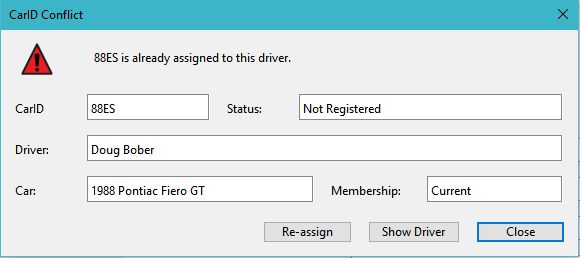
A red caution icon  means the CarID is already assigned to another
driver. Click the icon for details. If the conflicting driver is not registered, you can re-assign that
driver’s CarID. If the other driver is registered, you must choose a different CarID. No two drivers may
share the same CarID.
means the CarID is already assigned to another
driver. Click the icon for details. If the conflicting driver is not registered, you can re-assign that
driver’s CarID. If the other driver is registered, you must choose a different CarID. No two drivers may
share the same CarID.
Re-Classing a Driver
A driver may be re-classed at any time, even during a timed event. Enter the new number and/or class in the CarID field, then press Enter or Tab.
Tech Inspection
At the bottom of the Registration panel is the Tech Inspection area. You can optionally track each driver’s helmet date, inspection status, and notes. The helmet date is retained for the driver across events.
Bumping
Because bumping rules differ among national and local clubs, Finish-Time keeps the process flexible and straightforward.
Select View > Bumping, or click the Bump tab if it is already open.
Eligible classes for bumping appear on the left side of the panel. Use the drop-down menu to choose the class to bump into.
The table on the right lists all registered drivers as a reference. Sort by clicking column headers and resize columns as needed.
To Bump Drivers
- Classes eligible for bumping are listed on the left side of the panel.
- Open the drop-down for the class to bump, navigate the categories, and select the destination class.
To Un-Bump Drivers
- Classes eligible for un-bumping appear on the left side of the panel.
- Open the drop-down and select [----].
- To un-bump every driver at once, click the Reset toolbar button.
To Reset All Bumps
Clicking the Reset toolbar button returns every bumped driver to their declared class.
To Auto Bump
Finish-Time 4.1 introduced Auto Bump. By default it is configured with a sample schedule that you can replace with your own. The process follows each class table in order, starting at the top. See Auto Bump configuration for details on building a custom bump table.
Clicking the Auto Bump button processes every class according to the schedule until the minimum number of cars required for each class is reached.
Deleting Drivers
A driver can be deleted from the season database only if they have not been registered for any event. Delete from the Registration or Results panel by selecting the driver and clicking the Delete toolbar button.
If the driver had been bumped, Finish-Time recalculates the Bump after the deletion.
You can also right-click the driver in the Drivers List and choose Edit > Delete Driver.
Assignments
Work assignments and grid positions differ among clubs. The Assignments panel lets you assign run heats, work positions, and grid positions in any combination. Click column headers to sort or group drivers for easier selection. Assignments can be made individually during Registration or globally with the Work Assignment tools.
Clicking the Auto Assign toolbar button opens the Auto Assign dialog box.
To Assign Run Heats, Work Positions, and Grid Positions
- Select View > Assignments, or click the Assignments tab if it is already open.
- Select one or more drivers from the list. Click column headers to sort for better viewing.
- Choose the heat number and/or work positions to assign.
- Click the Grid cell for a driver, click again to activate it, and enter the grid number. Use the Up and Down arrow keys to move to the next driver and continue entering grid numbers.
Auto Assign
The Auto Assign function distributes drivers across the selected Work Heats so that each heat has as equal a total as possible. Whether the split is done by class or by individual driver is controlled by the Event Profile.
Any driver who does not already have a work assignment receives the Default Position. You can therefore assign specific drivers manually before running Auto Assign; those assignments are left unchanged.
Three Work Rotations are available:
- Next Position
- Run Work Rest
- Custom
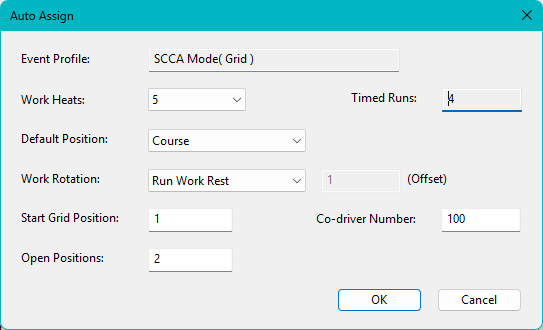
Start Grid Position defaults to 1 and can be set to any number. Finish-Time begins assigning grid numbers from that value.
Open Position defaults to 2 and can be set to any number. The corresponding grid slots are left open at the top of each grid.
Co-driver Number groups paired car numbers (for example 1 and 100, or 20 and 200) into the same run group and places them at the top of that group. Enter 0 to disable the feature.
Event Schedule
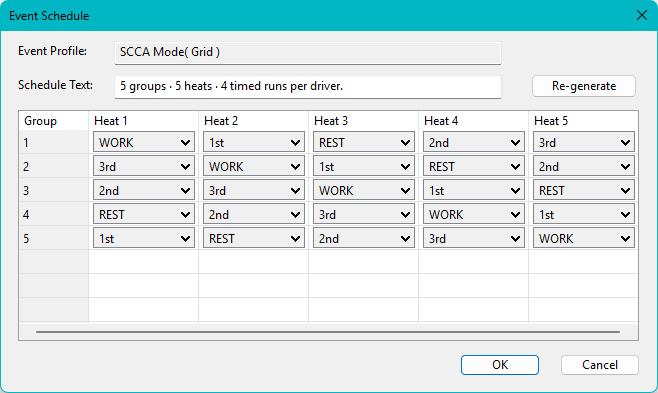
Click the Schedule toolbar button to open the Event Schedule dialog box. Finish-Time builds this schedule based the Event Profile, the number of Timed Runs scheduled and the Work Heats selected in the Auto Assign dialog. Use the drop-down menus to edit as you see fit.
Event Properties
Event Properties are the attributes of the current competition event. They are copied from the Event Manager but are independent of it and remain fully editable. In most cases you will not need to change them, but the option is always available.
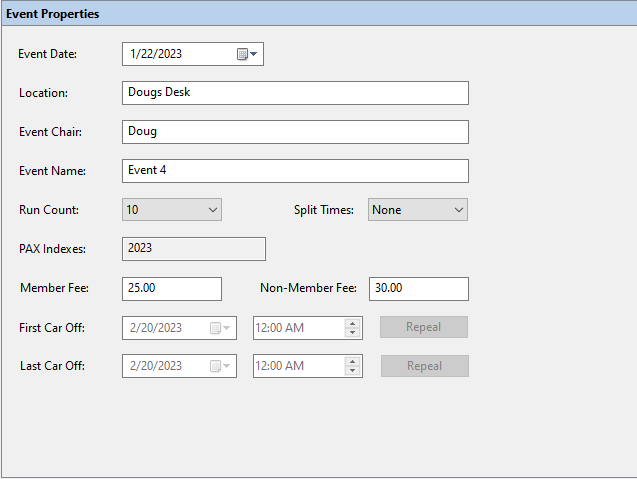
To view or edit Event Properties, select View > Event Properties. All changes take effect immediately.
The Event Profile menu configures the Auto Assign and Schedule functions. SCCA Mode (Grid) enables Grid Staging and Independant Mode (Linear) enables single line, numeric staging. The Auto functions adapt to each of these options.